
AI Supervision & Classroom Inspection System
AI Classroom Text
- AI Transcript: Complete speech-to-text transcript of the classroom session, displayed in paragraphs. Subtitles are highlighted synchronously with video playback. Subtitle search is supported; matched subtitles can be clicked to jump to the corresponding playback position.
- AI Sentence-by-Sentence Subtitles: Real-time speech-to-text transcription of classroom audio, with precise timestamp alignment for each teaching sentence. Supports subtitle search, position jump, online subtitle editing and correction, and export of subtitle files.
- AI Classroom Summary: Based on speech-to-text results and teaching event recognition, the system parses sequential subtitle text and combines classroom behavior recognition data. It automatically divides teaching stages, identifies core curriculum standard requirements, and detects key teaching events including teaching strategies, higher-order questions, cognitive conflicts, classroom management, and highlight moments, with bound timestamps. Click to jump to the corresponding time point for detailed data.
- AI Classroom Suggestions: Automatically generates several AI suggestions based on classroom records, providing data support for school teaching quality supervision and optimization advice for teachers.
AI Models
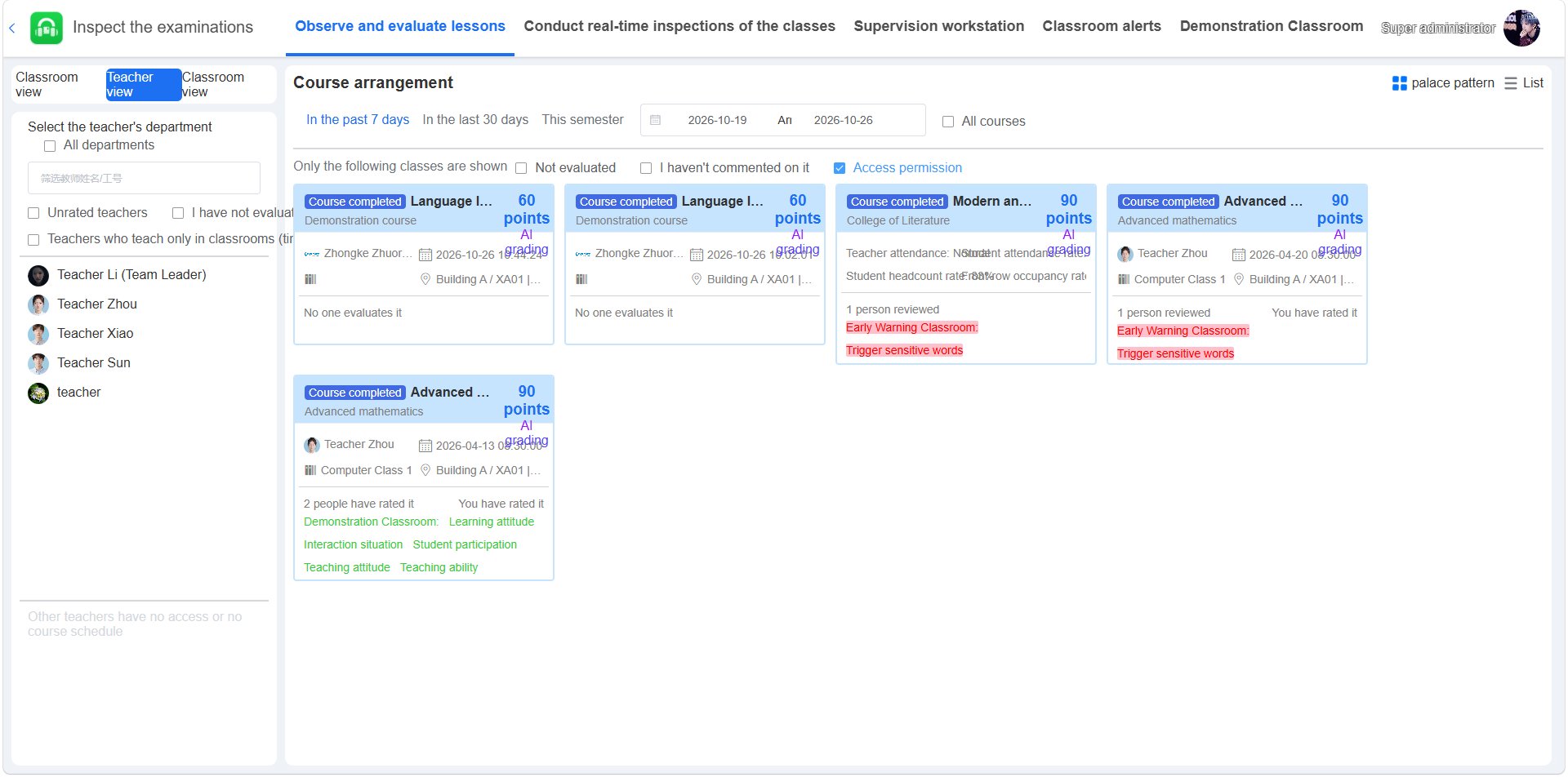
- AI Scoring: AI teaching scoring system that quantifies classroom quality from multiple dimensions and generates visual reports and improvement suggestions. Scoring dimensions cover teaching competence, teaching attitude, classroom atmosphere, interaction, student participation and learning attitude. Output includes radar chart visualization, teaching comments and AI scores.
- Bloom’s Taxonomy Question Classification: Based on Bloom’s taxonomy of educational objectives, the six cognitive levels (Remembering, Understanding, Applying, Analyzing, Evaluating, Creating) are displayed via radar chart. The AI automatically analyzes the cognitive level of classroom questions and quantifies the proportion of basic and higher-order cognitive questions to help teachers improve thinking depth in class.
- McCarthy Question Classification: Based on McCarthy’s 4W question framework (What, Why, How, What-if + Others), results are visualized on a radar chart. The AI automatically analyzes the distribution of question types and their proportions to support optimized question design.
- AI High-frequency Word Analysis: Automatically counts high-frequency words, filler words and sensitive words in class for quick identification of teaching focuses and verbal habits.
- Teacher Speech Rate Analysis: Real-time analysis of the teacher’s speaking rate, with quantified results and optimization suggestions against standard ranges.
- Classroom Time Allocation: Automatically calculates the duration ratio of each teaching segment and quantifies time allocation between teacher instruction and student activities to support classroom structure optimization.
- Teacher Movement Trajectory: AI automatically tracks and quantifies the teacher’s movement trajectory in class, recording time spent at the podium and patrol frequency.
- Teacher Expression Analysis: Real-time capture and intelligent analysis of the teacher’s facial expressions in classroom video. It identifies emotional fluctuations and status changes based on a 7-class emotion model (Happy, Neutral, Angry, Irritated, Scared, Sad, Surprised). It counts occurrences and time ratio of each emotion and generates an expression proportion chart.
- Classroom Time Allocation(结构化版本): Structured recognition and quantitative analysis of all teaching behaviors throughout the lesson, intuitively presenting the time proportion distribution of various teaching activities.
- Student Standing Analysis: Intelligent monitoring and data analysis of student body behaviors. It mainly counts the frequency and duration of students standing, and records typical behaviors such as head-down posture. It provides objective data for evaluating classroom engagement, teacher-student interaction and classroom management, and exports event screenshots and timestamps for key behaviors including head-down and standing states.
- S-T Teaching Behavior Analysis: Based on the S-T teaching analysis model, intelligent recognition and time-series analysis of teaching behaviors quantify the temporal distribution of teacher-dominated and student-dominated behaviors.
- Rt-Ch Teaching Analysis: Based on the Rt-Ch (Practice-Conversation) teaching classification theory, the system performs quantitative modeling and structural analysis of classroom activities. It identifies lecturing, practice and interactive conversation behaviors, calculates the key indicators Rt (Practice ratio) and Ch (Conversation ratio), and accurately determines the classroom teaching mode.
- Front-row Occupancy Rate: AI vision technology automatically calculates the student occupancy rate of front-row seats, as an indicator of students’ willingness to participate and course attractiveness.
- Student Head-up Rate: AI vision identifies and counts students’ head-up status, generating the average head-up rate and dynamic curve for the whole class as a core metric for student engagement and teaching attractiveness.
- Student Engagement Level: Powered by AI vision and facial landmark detection, the AI judges whether students are “looking forward and facing the classroom”. It calculates the proportion of engaged students, generates a fluctuation curve along the timeline for engagement changes, to evaluate teaching quality.
- PPT Slicing: AI vision recognition and content structuring technology intelligently associate classroom videos with teaching PPTs and conduct fragmented analysis. The system automatically extracts and segments PPT content, building a strong indexed link between video frames and PPT pages for efficient content retrieval and knowledge positioning for student review and teacher reflection.
- Mind Map: Generates visual mind maps based on classroom content. It automatically captures core knowledge points, key and difficult points, logical relationships and hierarchical structure. Meanwhile, it links teaching procedures, questioning sessions and interaction nodes, and intelligently builds a tree-structured map following teaching sequence and knowledge affiliation.
- Student Expression Analysis: Quantitative modeling and time-series trend analysis of student emotional states. AI vision recognizes students’ facial expressions and classifies them into seven states: Negative, Calm, Happy, Sad, Angry, Disgusted, Scared. It counts the number of students for each emotion at each timestamp, outputs time-series trend curves, locates emotional inflection points, and evaluates listening engagement and course attractiveness. Click peaks on the chart to jump to the corresponding time for details.
- Student Motion Analysis: Quantitative modeling and time-series trend analysis of student postures. AI vision identifies four motion states: Raising hand, Head-down on desk, Standing, Looking back. It counts the number of students in each state at each timestamp and outputs the St‑Mt time-series curve. It captures behavior fluctuation points to assist analysis of interaction activity, discipline and listening status. Click peaks on the chart to jump to the corresponding time for details.
- Student Behavior Analysis: Quantitative modeling and time-series proportion trend analysis of students’ listening status. AI vision calculates three percentage indicators: head-up rate, engagement level and front-row occupancy rate, and outputs a time-series trend curve of behavior proportion. It reflects the overall listening status of the class, locates time points where engagement declines, and evaluates teaching attractiveness and overall class listening quality. Click peaks on the chart to jump to the corresponding time for details.